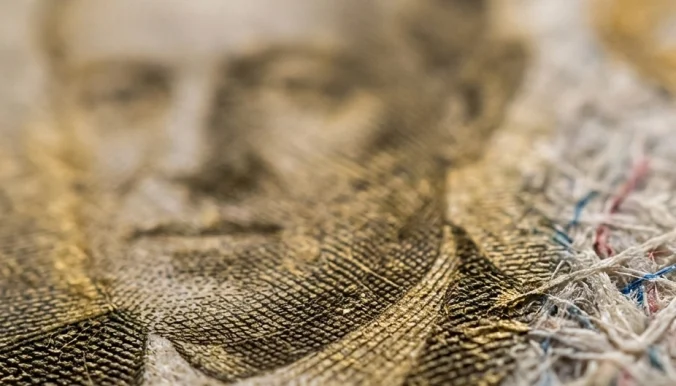
Design parts of a dollar bill function primarily as anti-counterfeiting measures.
Modern United States currency represents a highly sophisticated technological achievement.
Production oversight remains the responsibility of the Bureau of Engraving and Printing.
Wood-free paper forms the foundation of every bill.
Crane and Co. handles the exclusive manufacturing of this substrate.
| Parameter | Value |
| Composition | 75% Cotton, 25% Linen |
| Mass | 1.00 g |
| Length | 155.95 mm |
| Width | 66.29 mm |
| Thickness | 0.11 mm |
High wear resistance defines this specific material.
Withstanding 4,000 double folds ensures long-term durability during circulation.
Fabric-based construction prevents disintegration when exposed to water.
Ink Characteristics and Application
Magnetic ink allows for automated authenticity verification even via a bill and coin identifier.
Intaglio printing methods apply this ink to the surface.
Applying 20 tons of pressure creates the distinct raised image.
Black pigment on the front contains iron particles.
Green color on the back comes from a mixture involving chrome.
Color-shifting ink changes hue when viewed at an angle.
Copper color → Green color.
Multi-layer interference filters achieve this specific visual effect.
Security Fibers and Distribution
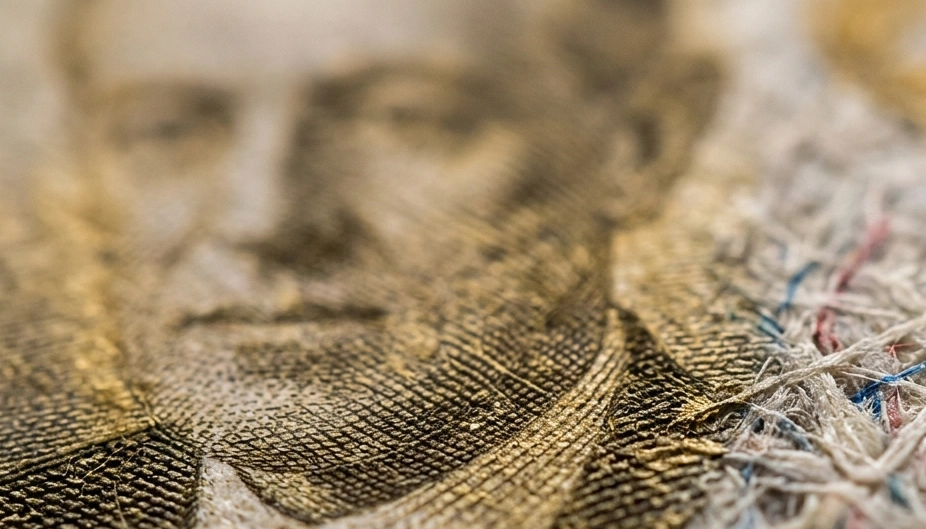
Synthetic threads are embedded directly into the paper structure.
These fibers appear in blue and red colors.
Embedding occurs during the initial paper formation stage.
Random distribution characterizes the placement of these threads.
Microscopic analysis easily identifies fake fibers created by surface printing.
Fibers do not glow under ultraviolet light.
Standard office paper reacts differently, distinguishing it from currency.
Security Thread and Watermark
A polymer ribbon stays buried inside the material.
Visible only when held against a light source, this feature remains hidden otherwise.
Each denomination features a unique thread position.
$100 bill → Left of the portrait.
$50 bill → Right of the portrait.
$20 bill → Left of the portrait.
Ultraviolet light causes the thread to emit a specific glow.
$5 → Blue.
$10 → Orange.
$20 → Green.
$50 → Yellow.
$100 → Pink.
A watermark duplicates the portrait of the historical figure.
Varying the density of the paper pulp creates this internal image.
Microprinting and Engraving
Fine lines form intricate patterns across the surface.
Standard scanners fail to reproduce microtext accurately.
THE UNITED STATES OF AMERICA appears on Benjamin Franklin’s collar.
Character height measures exactly 0.20 mm.
Steel tools carve portraits by hand to ensure precision.
Manual engraving creates a unique stroke texture.
Every line possesses sharp, defined borders.
Lacking blurred edges confirms the authenticity of the print.
2026 Market Value and Wear Analysis
Collector value depends entirely on the physical condition.
Professional grading scales verify the quality of the banknote.
| Denomination | UNC Condition | Gem CU Condition | Record Price |
| $1 (1928) | $55 | $180 | $12,500 |
| $2 (1953) | $15 | $45 | $3,200 |
| $5 (1963) | $25 | $85 | $5,800 |
| $100 (2009) | $110 | $250 | $18,400 |
Annual price fluctuations in the rare series sector:
- Economy Category: +2.1% per year
- Investment Category: +6.4% per year
- Rarity Category: +11.8% per year
Percentage price reduction based on physical creases:
Single vertical fold → -25% value.
Three or more folds → -60% value.
Stains or ink marks → -85% value.
Serial Number System
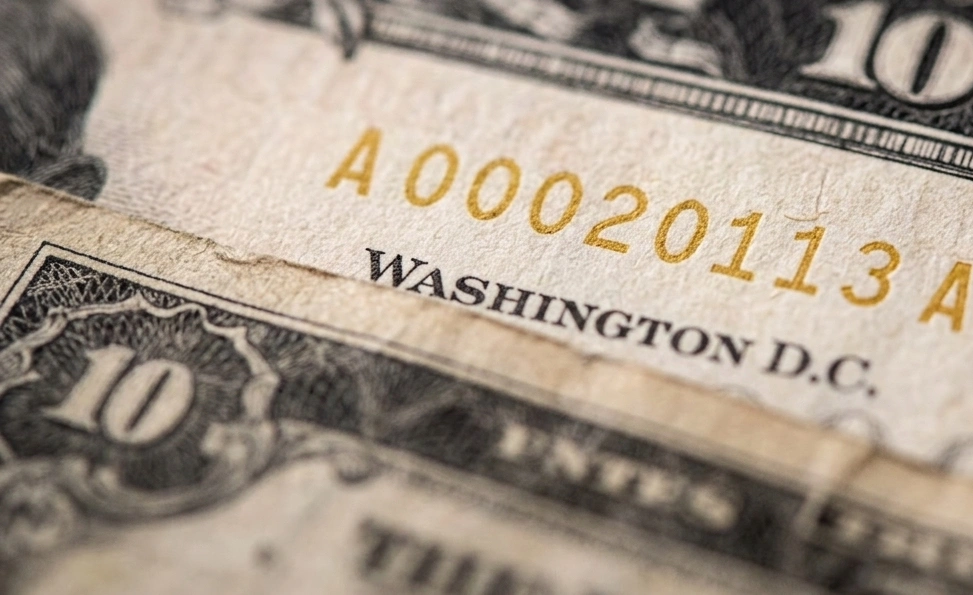
Letter and number combinations identify every individual note.
First letters indicate the specific series year.
Second letters designate the issuing Federal Reserve Bank.
A → Boston.
B → New York.
C → Philadelphia.
D → Cleveland.
E → Richmond.
F → Atlanta.
G → Chicago.
H → St. Louis.
I → Minneapolis.
J → Kansas City.
K → Dallas.
L → San Francisco.
A star replacing the final letter signifies a replacement for a damaged sheet.
Replacement notes account for 1% of total production volume.
Rarity increases their collector value by 40% on average.
Banknote Lifecycle Dynamics
Lifespan correlates directly with usage intensity.
Lower denominations wear out more rapidly.
$1 → 22 months.
$5 → 16 months.
$10 → 18 months.
$20 → 25 months.
$50 → 55 months.
$100 → 89 months.
Shredding facilitates the disposal of old money.
Processing facilities destroy 30 tons of banknote mass daily.
Symbols and Design Elements
Treasury seals confirm the legality of the tender.
Latin inscriptions reflect foundational state principles.
E PLURIBUS UNUM → Out of many, one.
ANNUIT COEPTIS → He has favored our undertakings.
NOVUS ORDO SECLORUM → New order of the ages.
Pyramids featuring an eye represent strength and permanence.
Thirteen steps form the pyramid.
This count matches the number of original states.
2026 Detection Methods
Infrared sensors detect empty zones on the bill.
Front-side printing utilizes infrared-sensitive inks.
Portions of the image disappear under infrared light.
Counterfeits typically reflect infrared light entirely.
Spectral analysis of paper composition eliminates errors.
Presence of starch in the material remains prohibited.
Iodine markers leave dark marks on wood-based paper.
Genuine cotton sheets keep the mark yellow that can be detected with the best coin identifier app free — yes, such apps works with the bills too.
Economic Production Aspects
Manufacturing costs vary by denomination.
$1 and $2 → $0.06 per unit.
$5 → $0.11 per unit.
$10 → $0.12 per unit.
$20 and $50 → $0.13 per unit.
$100 → $0.17 per unit.
Security budget growth in 2025 reached 4%.
Implementing 3D ribbons on the $100 bill increased costs by 15%.
Reasons for Removal from Circulation
Loss of mechanical strength triggers removal.
Surface contamination exceeding 30% renders a bill unfit.
Edge tears longer than 5 mm require replacement.
Missing more than 10% of total area disqualifies the note.
Fading colors from chemical exposure end the note’s life.
Automated sorting handles the removal process.
Scanners process 40 banknotes per second during inspection.
Preservation Factors
Moisture destroys linen fibers over time.
Temperature shifts cause ink to become brittle.
Optimal storage conditions:
- Temperature: +18 degrees.
- Humidity: 45%.
- Absence of direct sunlight.
Polyvinyl chloride holders must be avoided.
Acids in PVC materials cause paper yellowing.